Wednesday, December 14, 2022

Why You Should Know Vedic Maths?


Vedic scholars did not use figures for big numbers in their numerical notation. Instead, they preferred to use the Sanskrit alphabets, with each alphabet constituting a number. Several mantras, in fact, denote numbers; that includes the famed Gayatri Mantra, which adds to 108 when decoded.


Vedic Maths provides answer in one line where as conventional method requires several steps. It is an ancient technique, which simplifies multiplication, divisibility, complex numbers, squaring, cubing, square and cube roots. Even recurring decimals and auxiliary fractions can be handled by Vedic Mathematics. Vedic Mathematics forms part of Jyotish Shastra which is one of the six parts of Vedangas. The Jyotish Shastra or Astronomy is made up of three parts called Skandas. A Skanda means the big branch of a tree shooting out of the trunk.


In Vedic maths System a manual approach is preferred. The simplicity of Vedic Mathematics encourages most calculations to be carried out without the use of paper and pen. Methods like Shudh Method is applicable in statistics. This mental approach sharpens the mind, improves memory and concentration and also encourages innovation. It will be helpful in long run if we start implementing vedic Maths from Class 6 Maths.

USES OF VEDIC MATHEMATICS


It helps a person to solve mathematical problems 10-15 times faster


It helps m Intelligent Guessing


It is useful not only for junior classes but Class 9 and Class 10 Maths also.


It reduces burden (need to learn tables up to 9 only)


1. It is a magical tool to reduce scratch work and finger counting
2. It increases concentration.


3. It helps in reducing silly mistakes


This subject was revived largely due to the efforts of Jagadguru Swami Bharathi Krishna Tirtha Ji of Govardhan Peeth, Puri Jaganath (1884-1960). Having researched the subject for years, even his efforts would have gone in vain but for the enterprise of some disciples who took down notes during his last days. The basis of Vedic maths, are the 16 sutras, which attribute a set of qualities to a number or a group of numbers. The ancient Hindu scientists (Rishis) of Bharat in 16 Sutras (Phrases) and 120 words laid down simple steps for solving all mathematical problems in easy to follow 2 or 3 steps. Vedic Mental or one or two line methods can be used effectively for solving divisions, reciprocals, factorisation, HCF, squares and square roots, cubes and cube roots, algebraic equations, multiple simultaneous equations, quadratic equations, cubic equations, biquadratic equations, higher degree equations, differential calculus, Partial fractions, Integrations, Pythagoras Theorem, Apollonius Theoram, Analytical Conics and so on.

Vedic Maths Tricks


Vedic Maths Subtraction Tricks

Subtraction can be performed using 4 or 5 different methods in Vedic mathematics, and the best, as well as easiest way to subtract the numbers, is the Sutra Ekadhiken Purvena and Param Mitra Unka (the best friend). Here, two digits are called each other’s best friends if their sum is equal to 10. For example, 3 is the best friend of 7 since 3 + 7 = 10.

Go through the example given below to understand the subtraction of numbers by Sutra Ekadhiken Purvena.

Question:

Subtract 389 from 746.

Solution:

Steps for subtraction in Sutra Ekadhiken Purvena:

Step 1: Write the given numbers in rows and columns by giving some space between the digits.

Step 2: Consider column I (from the right end), 9 is greater than 6 so we cannot subtract it from 6.

1 is the best friend of 9 and add 1 to 6, i.e. 1 + 6 = 7. So write 7 in the answer place and mark Ekadhika dot(.) on 8, which is in the same row of column II such that it becomes 9 (as 8 + 1 = 9).

Here, dot(.) on the number represents one more than the previous number.

Step 3: Similarly, we need to subtract the remaining numbers. Thus, the answer will be:

Vedic maths subtraction

Therefore, 746 – 789 = 357.

Vedic Maths Multiplication Tricks

Like addition and subtraction, multiplication can also be done using different sutras in Vedic maths. In this section, you will learn two simple methods of multiplying numbers along with examples.

Method 1:

In this method, we can multiply the numbers whose unit digits are added up to 10 or powers of 10.

Let’s have a look at the solved example given below to understand the multiplication of numbers.

Example:

Multiply 63 and 67.

Solution:

63 × 67

Sum of unit digits = 3 + 7 = 10

Digits in tens places = 6

So, we can write the multiplication as:

63 × 67 = 6 × (6 + 1)/3 × 7

= 6 × 7/3 × 7

= 42/21

= 4221

We can also verify the result using normal mathematical calculations.

This method of multiplication is referred to as the Sutra Ekadhiken Purvena. This method can also be used to multiply two numbers whose last two digits are added up to 100, the last three digits are added up to 1000. Also, in the case of mixed fractions, the sum of proper fractions must be added up to 1 to apply this method of multiplication.

Method 2:

If two numbers are to be multiplied and one of these numbers is having only 9’s then we can apply this method.

Example:

Multiply 876 and 999.

Solution:

Given, two numbers are 876 and 999.

Now, subtract 1 from 876.

876 – 1 = 875

Subtract 875 from 999.

999 – 875 = 124

Thus,

876 × 999 = 876 – 1/999 – 875

= 875/124

= 875124

This method of multiplying numbers is Sutra Ekanyunena Purvena.

Similarly, there are many sutras in Vedic maths to perform the multiplication of numbers.

Vedic Maths Addition Tricks


Vedic Maths Addition Tricks

We have various tricks to perform the addition in Vedic maths. In this section, you will learn how to add numbers using one of the sutras called Ekadhikena Purvena with the help of an example.

Example:

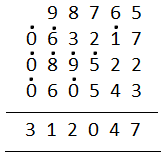
Compute: 98765 + 63217 + 89522 + 60543

Or

By Sutra Ekadhikena Purvena, add 98765, 63217, 89522, and 60543.

Solution:

Steps for adding numbers using Ekadhiken Purvena Sutra:

Step 1: Write the given numbers in rows and columns by giving some space between the digits.

Step 2: Column I (from the right side), add the first two digits, 5 + 7 = 12

Step 3: Mark Ekadhika dot(.) on 1, (digit which is next to 7 in column II)

Step 4: Now, start again adding with 2;

2 + 2 = 4

Again start with 4 such that 4 + 3 = 7

Step 5: Write 7 below at the answer’s place

Step 6: Add the remaining columns in the same way.

Thus, the final answer will be obtained as:

Vedic maths addition

Vedic Maths


Vedic Maths Benefits

The importance of Vedic Maths can be explained in various ways. The application of Vedic maths in the simplification of numerical problems is many times faster than the modern methods of calculations. Sometimes, this way of simplifying numerical calculations does not require paper and pen also. Thus, learning Vedic maths saves time and improves the interest in learning more applications of maths. Some of the benefits of Vedic mathematics sutras are listed below:

  • Calculations become easy and short.
  • Simplifications can be done in less time.
  • Students undergo less mental stress.
  • Results obtained by sutra-based methods can be easily verified with normal procedures.
  • The possibility of committing errors by students using these sutras is negligible
  • The use of sutras helps students to improve their knowledge and interest in the subject of mathematics.
  • Vedic maths helps to solve hard problems using mental calculations.

Vedic Maths Tricks

Vedic maths has many tricks to perform different mathematical operations such as addition, subtraction, multiplication, division, squares, square roots, etc. All these tricks help to compute the numerical problems in very little time when compared to the normal maths procedures. Vedic maths tricks reduce the time in finishing the calculations and create interest in learning more such tricks. Let’s have a look at some of the tricks along with examples for a better understanding here.


Vedic Maths Sutras


Vedic Maths Sutras

The list of Sutras and Subsutras are tabulated below:


S.No

Sutras

Sub-sutras

1

Ekadhiken Purvena

Anurupyena

2

Nikhilam Navatacharamam Dasatah

Sisyate Sesajnah

3

Urdhva-tiryagbhyam

Adyamadyenantya-mantyena

4

Paravartya Yojayet

Kevalaih Saptakam Gunyat

5

Sunyma Samyasamuchaye

Vestanam

6

(Anurupye) Sunyamanyat

Yavadunam Tavadunam

7

Sankalana-vyavakalamnabyam

Yavadunam Tavadunikrtya Varganca Yojayet

8

Puranapuranabhyam

Antyayoradaskaepi

9

Chalana-Kalanabhyam

Antyayoreva

10

Yavadunam

Samuccayagunitha

11

Vyastisamastih

Lopanasthapanabhyam

12

Sesanyankena Caramena

Vilokanam

13

Sopantyadvayamantyam

Gunitasamuccayah Samuccayagunitah

14

Ekanyunena Purvena


15

Gunitasamuccayah


16

Gunakasamuccayah

Why You Should Know Vedic Maths?

Vedic scholars did not use figures for big numbers in their numerical notation. Instead, they preferred to use the Sanskrit alphabets, with ...